Spec Battle: Royal Kludge L75 vs Wobkey Crush 80 — Is It Worth Upgrading?
Category: Laptops — keyboards and peripherals that complement laptop setups
Introduction
Compact mechanical keyboards have become a staple for laptop owners who want a better typing experience without sacrificing desk space or portability. Two names that surface when shoppers explore 75% and 80%-style boards are the Royal Kludge L75 and the Wobkey Crush 80. Both aim to balance a dense layout, modern connectivity, and the tactile or linear switch feel that enthusiasts and professionals gravitate toward. This article compares the two across real-world use cases — from remote work and content creation to programming and light gaming — and helps readers decide whether upgrading from an existing keyboard (or laptop keyboard) makes sense.
The goal is not just to list specs, but to evaluate how those specs translate into daily experience: typing comfort, key feel and sound, connectivity convenience, customization, and long-term value. Buyers care about build quality, switch choices, hot-swap capability, battery life and wireless stability, software support, and how easy the keyboard is to personalize. This comparison focuses on those priorities and provides an actionable buying guide at the end.
Product overviews
Royal Kludge L75 — What it aims to be
The Royal Kludge L75 is positioned as a compact 75% form-factor keyboard targeted at users who want most of the dedicated keys in a smaller footprint. Royal Kludge (RK) historically targets the value-conscious segment with boards that offer decent build quality, multiple connectivity modes (Bluetooth/2.4GHz/wired), and options for hot-swappable switch sockets on select SKUs. The L75 attempts to deliver a versatile daily driver for office work, casual gaming, and creative workflows.
Wobkey Crush 80 — What it aims to be
The Wobkey Crush 80 targets buyers who prefer a slightly more expanded layout — often called an “80%” layout — that adds a few dedicated keys while still being smaller than a full tenkeyless. The Crush 80 places an emphasis on typing refinement: stabilizer tuning, optional pre-lubed switch variants, and attention to acoustic character. Wobkey’s approach often skews toward enthusiasts who value the sound profile and feel as much as connectivity options.
Detailed analysis
Layout and ergonomics
Layout choice drives the day-to-day comfort of a keyboard. The Royal Kludge L75’s 75% layout typically groups arrow keys and a column of navigation keys near the right-hand cluster without occupying much desk width. This suits laptop users who keep their hands centered over the keyboard and want quick access to page up/down or home/end keys without needing function layers.
The Wobkey Crush 80’s 80% layout tends to preserve more dedicated keys (sometimes a full inverted-T arrow cluster plus a full column of nav keys). For users who frequently use arrow keys or navigational shortcuts — editors, spreadsheet users, and programmers — the Crush 80’s slightly larger footprint can reduce reliance on modifier-heavy layers and improve workflow speed.
Discover deals on Laptops & Computers — updated daily.
See Deals →Switch options and hot-swap
Switch selection defines feel. Royal Kludge typically offers its boards with a range of switch options from linear to tactile; some L75 variants are available with hot-swap sockets, letting users experiment without soldering. That is a big plus for people who like to test different switches or upgrade in the future.
Wobkey often focuses on switch refinement and may offer pre-lubed switch options or recommend particular third-party switches that pair well with the Crush 80. If Wobkey sells the Crush 80 in both soldered and hot-swap versions, enthusiasts are advised to choose hot-swap if they plan to tailor the typing experience.
Build materials and keycaps
Royal Kludge boards frequently mix ABS keycaps on baseline models with PBT options on higher-tier SKUs. The L75’s chassis is usually a combination of plastic with possibly a metal plate, which keeps costs down while remaining sturdy for typical use. Keycap profile and quality will strongly affect longevity and feel; ABS keycaps shine early but show shine faster than PBT.
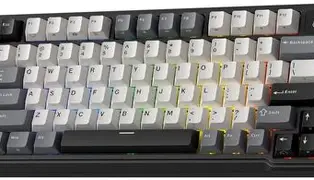
Wobkey’s Crush 80 often emphasizes higher-quality materials if its target audience is enthusiasts. That can mean PBT keycaps, better legends, and an improved case finish. These touches matter for users who type for long sessions and want consistent texture and minimal shine over time.
Stabilizers and typing sound
Stabilizers (the mechanisms under longer keys like spacebar and enter) are a surprisingly large factor in perceived quality. Royal Kludge tends to provide acceptable stock stabilizers that may require tuning (lubing, clipping) to reach quieter, rattle-free performance.
Wobkey’s attention to acoustic profile often includes better-out-of-the-box stabilizer prep or recommendations for tweaks. For people who record audio, stream, or require quieter office setups, Wobkey’s tuning can be a differentiator.
Looking for the best Laptops & Computers deals on Amazon?
Shop Amazon →
Connectivity and battery life
Both boards usually offer wired USB-C connectivity and at least one wireless mode. Royal Kludge models commonly provide Bluetooth multi-host pairing and a 2.4GHz dongle for lower-latency wireless, which is useful for switching between a work laptop and a home PC. Battery life depends on backlighting and usage; buyers should expect multi-day battery life in moderate use with RGB disabled and shorter spans if using bright lighting modes.
Wobkey tends to deliver similar connectivity options but may prioritize a slightly improved wireless stack or antenna placement for more stable Bluetooth performance. For frequent travelers who use a keyboard with a laptop, Bluetooth convenience and reliable reconnection are critical.
Software and customization
Royal Kludge provides a basic configurator for remapping keys and macro recording on some models, though it isn't always as feature-rich as enthusiast tools. Users who rely on on-board profiles and simple macros will likely be satisfied, but power users who need deep layer programming may find limitations.
Wobkey often leans into more advanced configurability, sometimes offering improved firmware or community-supported tools. This matters for users who want layered layouts, complex macros, or per-key RGB effects tied to software — for them, the Crush 80 may feel more flexible.
Comparison at a glance
| Feature | Royal Kludge L75 | Wobkey Crush 80 |
|---|---|---|
| Layout | 75% compact with dedicated arrow cluster and nav keys | 80% slightly wider with more dedicated nav keys and arrow cluster |
| Hot-swap availability | Available on some SKUs (depends on variant) | Common on enthusiast-focused SKUs; varies by model |
| Switch options | Broad: linear, tactile, clicky (OEM or RK-branded) | Emphasis on tuned or pre-lubed options; recommends compatible third-party switches |
| Keycaps | ABS standard; PBT on select SKUs |