Dwarflabs Dwarf III Specs, Features, and Value: Is it worth the price tag?
The landscape of amateur astronomy and long-range photography has shifted dramatically in recent years. For decades, the barrier to entry for astrophotography was steep, requiring not only expensive equatorial mounts and heavy optical tubes but also a deep knowledge of polar alignment, calibration frames, and complex post-processing software. This exclusivity began to crumble with the advent of the smart telescope—a portable, integrated system that handles the heavy lifting of tracking and stacking automatically. Leading this charge in the compact category is DwarfLabs, whose latest iteration, the Dwarf III, seeks to redefine what a "smart" optical device can be. This article explores whether this pocket-sized powerhouse justifies its cost by examining its technical specifications, real-world utility, and the unique value proposition it offers to modern hobbyists.
The Evolution of the Dwarf Series
To understand the Dwarf III, one must first appreciate its lineage. Its predecessors, the Dwarf I and II, carved out a niche as the "Swiss Army Knife" of digital telescopes. While competitors focused almost exclusively on deep-sky objects, DwarfLabs pursued a dual-purpose design: a device equally capable of capturing a distant nebula at midnight and a rare bird in a forest at noon. The Dwarf III represents a significant maturation of this concept. It is not merely a refined version of the previous models; it is a re-engineered platform designed to address previous limitations in resolution, sensor sensitivity, and user experience.
The primary appeal of the Dwarf III lies in its "all-in-one" nature. It integrates the lens, the sensor, the motorized mount, and the computing brain into a single chassis roughly the size of a large dictionary. For travelers, hikers, and urban dwellers with limited storage space, this form factor is a revelation. However, compact size often comes with optical compromises. The question for many potential buyers is whether the Dwarf III has managed to overcome the physics of its small aperture to deliver images that truly satisfy the discerning eye.
Detailed Technical Specifications
The core of any camera or telescope is its optical and sensor stack. The Dwarf III utilizes a periscope-style optical system to maintain its slim profile while achieving the focal length necessary for astronomical observation. This design is paired with an updated sensor and a more robust internal processor to handle the demanding tasks of AI-driven object recognition and image stacking.
One of the most notable technical shifts in the Dwarf III is the move to a higher-resolution sensor with improved low-light performance. In the world of smart telescopes, "signal-to-noise ratio" is the metric that determines success. Because these devices use relatively small apertures, they must rely on software to combine dozens or even hundreds of short exposures. The Dwarf III’s sensor is designed with larger pixels to capture more photons per second, which is critical when tracking faint deep-sky targets like the Orion Nebula or the Andromeda Galaxy.
Imaging and Optics
The device features a dual-camera system. The wide-angle lens serves as a "finder," providing a broad field of view that allows users to orient themselves and select targets. The telephoto lens is the primary tool for detailed work. This dual-lens approach is essential for a device that lacks a traditional optical viewfinder. The software seamlessly switches between the two, allowing the user to "zoom in" digitally and optically on a specific area of interest. The telephoto lens has been improved with higher-grade glass coatings to reduce chromatic aberration, a common issue in previous models where purple fringing would appear around bright stars or high-contrast bird feathers.
Processing and AI Capabilities
Inside the Dwarf III is a dedicated NPU (Neural Processing Unit). This is the "brain" that enables features like automatic bird tracking and star pattern recognition (plate solving). When you point the Dwarf III at a seemingly empty patch of night sky, the NPU analyzes the stars it sees, compares them to an internal database, and calculates exactly where it is pointing within seconds. This allows the motorized alt-azimuth mount to track the Earth’s rotation with high precision, preventing star trailing during long exposures.
Core Features and User Experience
Functionality is where the Dwarf III distinguishes itself from traditional DSLR setups. The user experience is almost entirely app-driven, connecting via Wi-Fi or Bluetooth to a smartphone or tablet. This allows the observer to stay inside a warm house or car while the telescope sits outside in the cold, a luxury that veteran astronomers find increasingly attractive.
Find top-rated Cameras & Photography products at great prices.
Shop Amazon →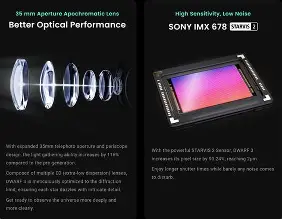
Astrophotography: The Deep Sky Mode
The standout feature is undoubtedly the Deep Sky (DSO) mode. In this mode, the Dwarf III automatically slews to a target—for example, the Lagoon Nebula—and begins taking 15-second exposures. As each image is taken, the internal computer aligns it with the previous frames, "stacks" them to reduce noise, and "stretches" the data to reveal colors and details invisible to the naked eye. Within ten minutes, a vivid, colorful nebular structure begins to emerge on the smartphone screen. For the Dwarf III, the "Value" here is time. What used to take hours of manual setup now takes a few taps on a screen.
Terrestrial Photography and Birding
Unlike many smart telescopes from brands like Unistellar or ZWO, the Dwarf III is a capable daytime tool. It features specialized AI tracking for animals and birds. If a hawk is circling in the distance, the Dwarf III can lock onto the subject and follow its movement smoothly. This makes it an excellent companion for nature enthusiasts who want to document wildlife without lugging around a 600mm lens and a heavy tripod. The inclusion of an ND (Neutral Density) filter slot also allows for solar photography, making it possible to safely capture sunspots and solar eclipses.
Portability and Battery Life
The Dwarf III is powered by a high-capacity internal battery that generally lasts through an entire night of shooting or a long day in the field. It supports USB-C charging, including charging via power banks while in use. Its weight—often under 1.5 kilograms—means it fits easily into a backpack. This portability defines its use case: it is the telescope you actually take with you, rather than the one that gathers dust in the garage because it is too heavy to move.
Performance Comparison
To better understand where the Dwarf III sits in the market, it is helpful to compare it to its primary competitors and its predecessor. The following table highlights the key differences in specifications that matter most to users.
| Feature | Dwarf II (Previous) | Dwarf III | Generic Competitor (Entry Level) |
|---|---|---|---|
| Sensor Resolution | 8 MP | 12-16 MP (Enhanced) | 6.5 MP |
| Aperture | 24mm | 35mm (Estimated Equivalent) | 50mm |
| AI Processing | Basic Tracking | Advanced NPU-driven Tracking | Cloud-based solely |
| Storage | SD Card Slot | Large Internal + Slot | Internal Only |
| Weather Resistance | Minimal | Improved Seals | None |
Pros and Cons
Every piece of technology involves trade-offs. The Dwarf III is a master of versatility, but it is not a "magic bullet" for all types of photography. Understanding these pros and cons is vital for determining its value.
Pros
- Extreme Portability: Its compact rectangular design is far easier to pack than traditional tube-shaped telescopes.
- Versatility: Effectively functions as a telescope, a telephoto camera, and a high-end spotting scope in one device.
- Ease of Use: The learning curve is significantly shallower than traditional astrophotography; most users can get their first nebula photo within 15 minutes of unboxing.
- Dual Camera System: The wide-angle finder lens makes target acquisition much less frustrating than single-lens systems.
- Cost-Effective: Compared to buying a tracking mount, a DSLR, and various lenses, the Dwarf III is a budget-friendly entry point into the hobby.
- Quiet Operation: The motors are remarkably silent, which is beneficial for wildlife photography where noise can scare away subjects.
Cons
- Aperture Limitations: With a small physical aperture, it will always struggle with very faint or small galaxies compared to larger, more expensive smart telescopes.
- Digital Zoom Limits: While the optics are good, pushing the digital zoom too far results in significant pixelation and loss of detail.
- Fixed Battery: Like many modern electronics, the internal battery is not easily swappable in the field, though it can be charged via power bank.
Buying Guide: Is the Dwarf III Right for You?
Deciding whether to invest in the Dwarf III requires an honest assessment of your goals as a photographer or observer. It is not a professional-grade observatory instrument, nor is it a simple point-and-shoot camera. It occupies a unique middle ground.
Who should buy the Dwarf III?
The ideal buyer is the "Casual Explorer." If you love the idea of seeing the rings of Saturn or the dust lanes of the Orion Nebula but have no interest in spenting three hours setting up equipment, this is for you. It is also a perfect choice for Travelers. If you frequently visit dark-sky parks or go on camping trips, the Dwarf III provides a way to engage with the night sky that a smartphone simply cannot match. Finally, Nature Enthusiasts who want a "smart" spotting scope that can record high-quality video of distant animals without the bulk of a full tripod setup will find immense value here.
Discover deals on Cameras & Photography — updated daily.
Shop Amazon →Who should skip it?
If your primary goal is High-Resolution Planetary Imaging, you might be disappointed. Capturing fine details on Jupiter or Mars requires a much larger aperture and longer focal lengths than a compact device can provide. Furthermore, Professional Astrophotographers who enjoy the "manual" process of guiding and individual sub-exposure calibration will find the automated "black box" nature of the Dwarf III's processing to be limiting. If you want total control over every pixel, a modular setup is still the better, albeit much more expensive, path.
The Value Proposition: Is it worth the price?
To determine value, we must look at what "the price tag" actually buys. When you purchase a Dwarf III, you aren't just buying a lens and a sensor; you are buying a curated experience. The value lies in the software integration. The ability to select "M31" from a menu and have the telescope find it, track it, and photograph it while you sit by a campfire is the primary product being sold.
If you were to attempt to replicate the Dwarf III's functionality with discrete parts, you would need a small equatorial mount (approx. $300-$500), a camera body (approx. $400-$800), a telephoto lens (approx. $300), and a laptop or dedicated astro-computer like an ASIAIR (approx. $200). You would also need various cables, batteries, and a much larger tripod. This "manual" equivalent would cost significantly more and weigh ten times as much. From this perspective, the Dwarf III is an incredible bargain. It democratizes a hobby that was once restricted to those with deep pockets and even deeper patience.
Real-World Use Cases
Consider the "Backyard Session." In a light-polluted city, traditional telescopes often struggle because the faint light of a nebula is washed out by the orange glow of streetlights. The Dwarf III’s software uses aggressive stacking algorithms that can often "see through" light pollution better than the human eye can through an eyepiece. This makes it a viable tool for urban astronomers who want to see the cosmos from their balcony.
Consider the "Birding Expedition." A birder spots a rare nesting pair across a canyon. Instead of trying to hold a smartphone up to a pair of binoculars (digiscoping), they set the Dwarf III on a rock, use the app to lock onto the nest, and record 4K video. The AI ensures the nest remains centered even if the wind shakes the device slightly. This level of utility spans across different hobbies, which is rare in the optics industry.
Conclusion
The Dwarflabs Dwarf III is a testament to the power of computational photography. It successfully bridges the gap between a high-end consumer gadget and a legitimate scientific tool. While it cannot defy the laws of physics—a larger telescope will always capture more light—it maximizes every millimeter of its aperture through clever software and robust hardware. Is it worth the price tag? For the individual who values portability, speed, and the sheer joy of discovery without the technical headaches, the answer is a resounding yes. It represents a new era of observation, where the wonders of the universe and the natural world are accessible to anyone with a smartphone and a sense of curiosity. As long as you understand its limitations regarding deep-sky reach and planetary detail, the Dwarf III stands as one of the most versatile and enjoyable optical instruments on the market today.